by Kristiana Lowe
The CRAG is excited to welcome all community members to our current exhibition, Three Eyed Seeing: Indigenous Futurisms co-curated by Sonny Assu and Jenelle M. Pasiechinik. The Exhibition runs from June 5th -August 23rd, 2025.

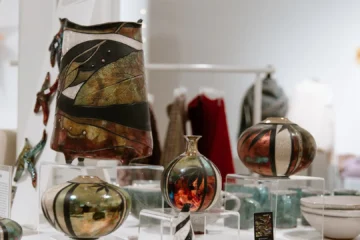
Featuring work by artists Melcolm Beaulieu, Mimi Gellman, Krystle Silverfox, Nadya Kwandibens, Levi Nelson, Casey Koyczan, Carrielynn Victor, Shawn Hunt and Eliot White-Hill Kwulasultun, Three-Eyed Seeing: Indigenous Futurisms explores how Indigenous identity and culture is a critical part of the past, present and future.1 Through a diverse range of mediums, including oil-painting, video, virtual reality, textiles and more, the artists have imagined a future that is guided by the wisdom of their ancestors and that is rooted in Traditional Knowledge and practices.

The gallery’s current exhibit is directly engaged with the theory of Indigenous Futurisms. This social theory, which has been developed over the last 20 years and is inspired by the work of Afro-Futurisists, aims to bring Indigenous perspectives to the forefront of contemporary dialogue and to resist the ongoing erasure of Indigenous people’s voices, history, and traditions.2 It offers Indigenous people a space to reflect on their own personal and collective experiences as an empowering means of reclamation in the face of settler-colonialism.3

For this exhibit, the artists expressed their own unique way of relating to the idea of futurisms. Anishinaabe, Métis, and Ashkenazi artist Mimi Gellman honours her mother and Métis heritage through her installation piece Stones My Mother Left Me.4 Inspired by the idea of what it would mean “to wear our medicines,” Gellman recreated both a traditional Métis hide suit out of tobacco and a jingle dress that features sage jingles and a ceremonial collar which depicts the star map of the night her mother was born.5 The garments are each called “Traveler,” a nod to how both past and future inspired their making.6 When asked what Indigenous futurisms mean to her, Gellman states, “it is a way of acknowledging how I think about the passage of time.” Reflecting on how the future is ancestral, she says, “I really strongly believe that the hope for our future is, yes, in our youth, but that our ways of being and thinking and doing comes from our ancestry, are taught to us by our ancestors, and that it is those values that will lead us into having a good future.”7

Artist Eliot White-Hill, Kwulasultun explores in his piece Rez to be Seen From Mars his cultural and multi-generational inspirations while also tackling environmental issues and colonization. In his work, the artist references a conceptual piece by Isamu Noguchi, whose original work was intended to act as a sign visible from outer space in the event of a possible destruction of humankind.8 Kwulasultun was inspired to draw from Noguchi by his own love for the artist’s work, a love he inherited from his father, and from a shape appearing in the original work that is evocative of a Northwest Coast ovoid.9 In Rez to be Seen From Mars, Kwulasultun also explores the nature of colonial practices by linking together ideas of “escaping” climate disaster – through leaving earth behind via space travel – with how Indigenous people’s mobility has been controlled through colonial notions of the reserve, or “rez.”10 The artist brings attention to how issues surrounding the displacement of people historically deemed “inconvenient” by colonizers and the refusal to adequately address environmental issues can be seen as connected by drawing on his own cultural, familial, and artistic influences.

For the exhibition, The CRAG has run various events concerned with Indigenous Futurisms and notions of Indigenous Sovereignty. On June 19th, the gallery hosted a storytelling workshop and acoustic set by Montreal-based queer Indigenous pop singer/songwriter Siibii. After a welcome song performed by Will Henderson, Siibii shared with local community members their knowledge of Indigenous storytelling traditions, and told stories passed down by their culture as well as their own personal tales connected to Indigenous tradition and knowledge. Attendees also had the chance to hear the first acoustic renditions of three of the singer’s songs: Love is Up the River, YOY, and Savage. The event was a night of community listening, learning, and coming together to take part in the living nature of Indigenous identity and futurisms.

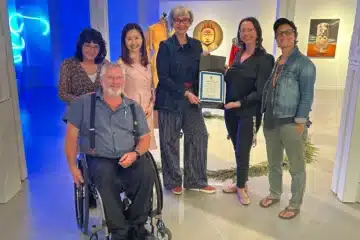
The diverse range of artists and mediums presented at Three-Eyed Seeing: Indigenous Futurisms showcases the thriving interconnectivity between Indigenous pasts and futures, along with the diverse ways people can interact with their traditions. Speaking at the exhibit’s opening reception, co-curator Sonny Assu described the exhibit’s works as “rooted in traditional iconography and ancestral ways of making.” He expressed how a method of “three-eyed ways of seeing”, where past, present, and future are understood to be connected, offers hope and healing and that the exhibition showcases “what we as Indigenous people are making now to inspire future generations.” The Campbell River Art Gallery’s current exhibit offers insight into the wide possibilities of Indigenous Futurisms and Indigenous contemporary artists today, as well as the vital role that local arts and culture plays in uplifting and inspiring communities all across Turtle Island through sharing diverse voices and perspectives.

Three-Eyed Seeing: Indigenous Futurisms will run from June 5th to August 23rd. A two-day beading workshop with Métis interdisciplinary artist Carly Nabess will run July 27-July 28, and on August 6, join us at Spirit Square for Art Attack on the Row! All events are barrier free and by donation. You can register online at our website at www.crartgallery.ca/events.
Notes
- Current Exhibitions. (Campbell River Art Gallery, 2025).
2. Chelsea Vowel, “Writing Toward a Definition of Indigenous Futurism”. (Literary Hub, June 10, 2022).
3. Adam Killick. “Changing the narrative in science fiction and fact”. (CBC, May 28, 2021).
4. Mimi Gellman. (Artist Label, 2025.)
5. Mimi Gellman. (Interview by Kristiana Lowe, 2025.)
6. Mimi Gellman. (Interview.)
7. Mimi Gellman. (Interview.)
8. Elliot White Hill, Kwatsulan. (Artist’s label, 2025.)
9. Elliot White Hill, Kwatsulan. (2025.)
10. Jenelle M. Pasiechnik. (Curatorial Talk, 2025.)
Bibliography
“About.” Red Works.
Curatorial Talk By Jenelle M. Pasiechnik, June 2025.
“Current Exhibitions.” Campbell River Art Gallery, 2025.
Gellman, Mimi. Interview by Kristiana Lowe, June 4, 2025.
Hunt, Shawn. Three-Eyed Seeing Indigenous Futurisms exhibition opening reception speech, 2025.
Killick, Adam. “Changing the narrative in science fiction and fact”. CBC, May 28, 2021.
“Siibii”. Emerging Musician Program.
Vowel, Chelsea. “Writing Toward a Definition of Indigenous Futurism”. Literary Hub. June 10, 2022. Accessed June 4. 2025.
White-Hill, Kwatsulan, Elliot. Artist Label, 2025.